


Stories from the Archive
Lív Brownlie recently completed a placement in the Archive as part of undergraduate studies in the History and Art and Archaeology at the University of Glasgow. Here she reflects on some of the stories that can be told using the exhibition ephemera catalogues as part of her placement.
Stories from the Archive
Artists are well known for their tendency towards collecting and documenting, from the antiquarian cabinets of curiosities of the 18th century to the growing popularity of hobbyists in the mid-century, allowing for the transformation of collecting habits into aesthetic modes and artforms which were focused on assemblages and series. Wilhelmina Barns-Graham undoubtedly shared this inclination, and, significantly for the archives, she tended to collect personal effects, preserving the products of her work and life.
As a continuation of the cataloguing of flyers, exhibition catalogues and private view invitations, we’ve been looking at archiving the aforementioned personal effects, which in this case are the accumulated group exhibition and general gallery ephemera, which gives a unique look into the histories of British galleries, of wider artistic movements and the type of work that Barns-Graham had an interest in. Viewing her collections individually through the British group exhibitions to which Barns-Graham was invited or attended provides a unique insight into an artist’s life as both a participant and a witness to changes in the art world throughout the 20th century.
A lot of the things she collected throughout her life don’t lend themselves to drawing narratives about her life and interests, as most are unmarked, untouched, even, apart from a flurry of notations and phone numbers every now and then. But what they reveal is aspects of the British art scene, the lives of other artists, and the changes she witnessed. Through Barns-Graham’s collection of private-view invites, exhibition catalogues and gallery programmes, we can piece together different stories from the ones the Trust usually uncovers, from the development of art movements to how the aesthetics of graphic design have changed, allowing us to reflect on what about art in Britain has changed and what has stayed the same.
Tate Modern
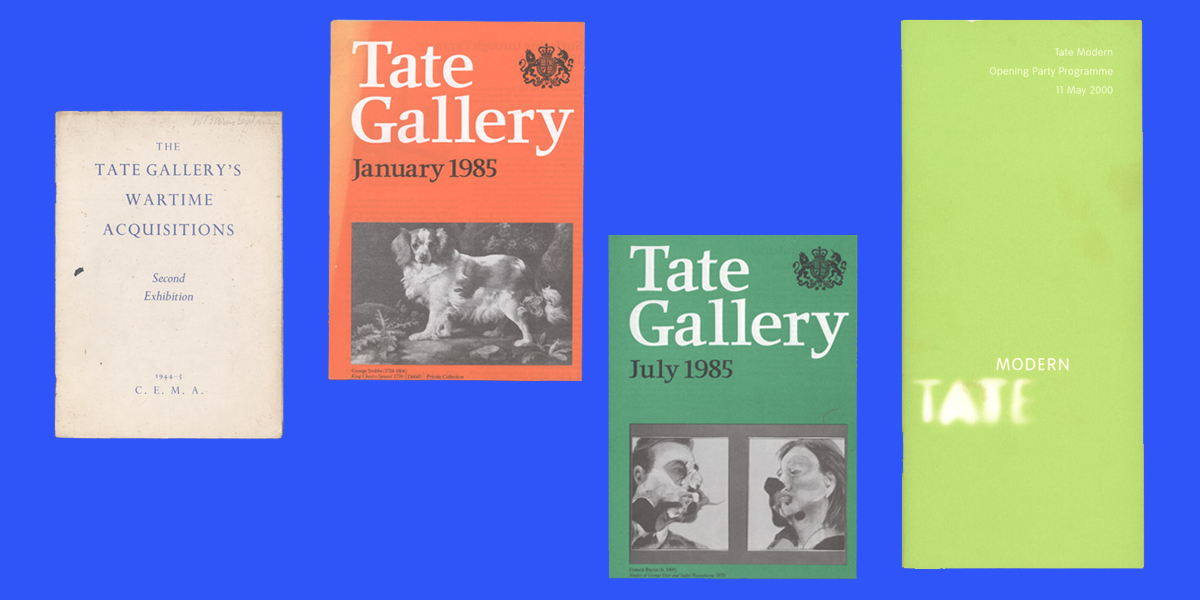
The galleries that she had a particular interest in or that have been very influential over the last century have extensive collections of their own. Tate is known worldwide for its galleries, and today most famously for the extensive collections of Tate Modern, housed in the Sir Gilbert Scott-designed power station on the Southbank of the Thames. Tate Modern, however, only opened in 2000 and was previously the diverse and eclectic Tate Gallery, now Tate Britain on Millbank. This quantum shift allowed Tate to change its output in a revolutionary sense. An early example from Barns-Graham’s collection is a 1944-5 exhibition catalogue from the Tate on wartime acquisitions, a functional piece with a limited colour palette. By the 1980s, the distinctive palate of single bright-coloured catalogues had developed, and we can also identify a focus on exhibiting modern and abstract art. Finally, the pamphlets from the early 2000s are bright, glossy, and clean, evoking a distinct sense of nostalgia for someone like me who spent their early years stumbling through the turbine halls. The collection might just help to reveal the transition from the collections of a very British maverick into the international powerhouse it is today, perhaps even a world leader in the art scene, as well as give us insight into the subtle changes in the graphic design of such an institution over the decades.
Common Ground
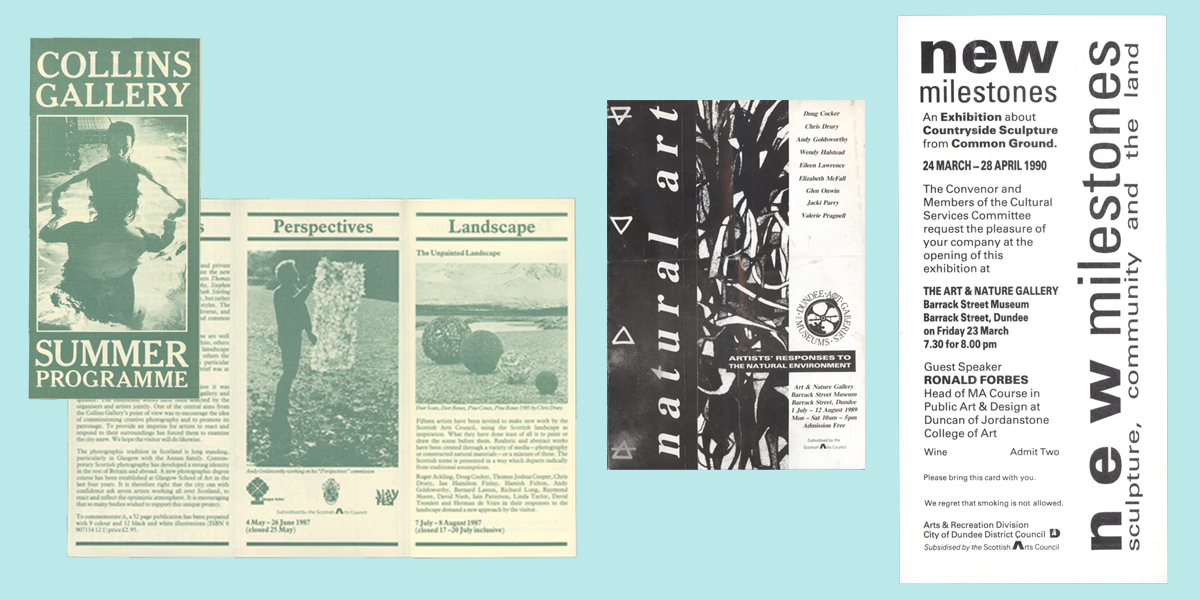
Across the ephemera of various galleries, traces of ideas that grow into movements appear. When working with archival material, the devil is in the details, and what might be inconspicuous to one person will jump out to another. For me, a series of catalogues for exhibitions on landscape and nature sparked some interest, and, with further examination, I identified a small collection relating to the work of and surrounding the Dorset-based arts and environmental charity Common Ground. It was founded in 1983 by Sue Clifford, Angela King and Roger Deakin, and sought to use art to engage people with their local environment. Still around today, the projects have captured the imagination of communities across the country and spread knowledge of and connection to the landscapes we live in. Launched in 1986, its first significant initiative, aside from publications, was the New Milestones Project, which is still evident in Dorset’s landscape today. It focused on funding communities to commission outdoor sculptures to celebrate what could be seen as commonplace environments, but that have deep significance to the people who live there. (including me!) One example was the 1986 creation by Andy Goldsworthy of a new entrance to Hooke Park, made entirely from material sourced from the woodlands. This work corresponds with a modern-day revival of folk art and a return to the land, responding to a time of environmental instability and uncertainty, as well as to the over-commercialisation of art. The concentration of such examples both demonstrates Wilhelmina Barns-Graham’s interests and reveals the relevance of the archival material to the arts and cultural movements today.
CCA/The Third Eye Gallery
As there are beginnings, there are endings, which became the case in January 2026 for the Centre for Contemporary Arts, or the Third Eye Gallery in Glasgow. A longstanding cornerstone for art in Scotland, its closure reveals a precarious future for art institutions. In no way an isolated case, with the tenants of another cornerstone institution, Trongate 103, having their leases terminated in February 2026, it follows a pattern not just seen in Glasgow but across Britain and beyond, in which the artists often become collateral damage in institutional failings.
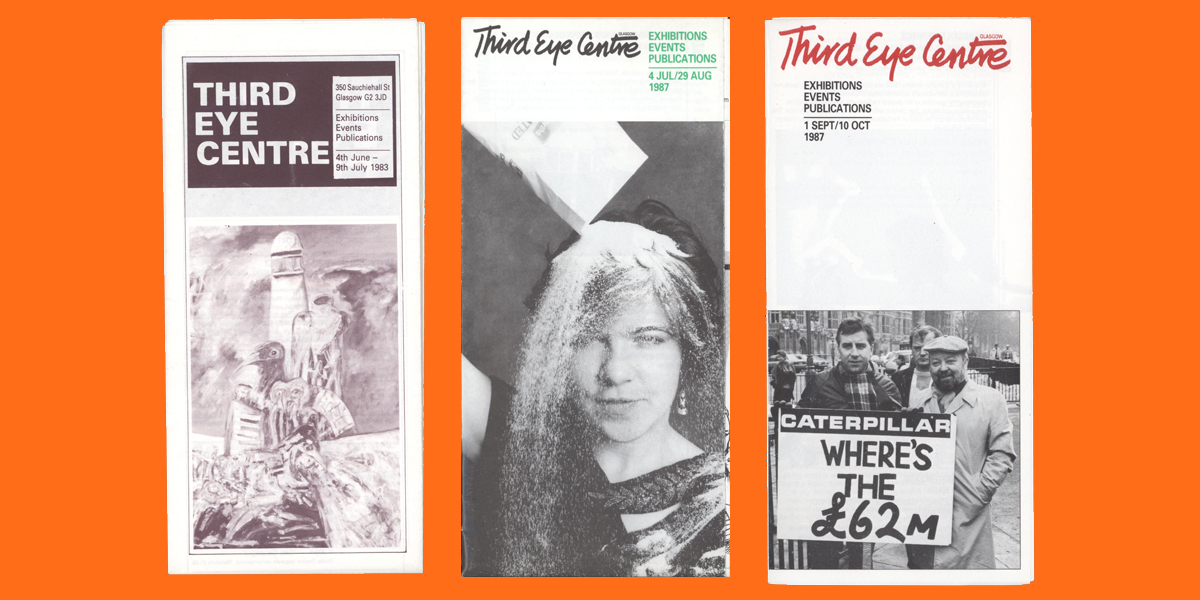
The CCA programme from 1983 reveals its network of collaborations with public institutions in Glasgow; Glasgow district libraries (specifically the Mitchell library), the Glasgow Film Theatre, and the Glasgow district council, to produce a variety of publications, screenings, and exhibitions. The publication Noise and Smokey Breath, an illustrated anthology of Glasgow Poems 1900-1983, reveals an important collaboration not just among institutions but also among artists and poets. It attempts to define a city that was, for the first time, as poet Edwin Morgan suggested in his address to open the exhibition and publication, ‘beginning to express itself, to find its own voices and images’. It is a captivating demonstration of how artists are both defined by and define the places they live in, as do the places that work to create and publish such collaborative efforts. The importance of other archives in preserving the history of such places cannot be overstated, especially given the unknown future of their extensive archives. They help to contextualise Scottish culture and make available to the public what has been lost, in the hope that a revitalisation of such spaces will eventually occur.
The WBGT would like to express our thanks to Lív Brownlie for the excellent work she completed while on placement with us at the beginning of this year.