


Reading Relationships: Reacquired Books and Archival Afterlives in The Library of Wilhelmina Barns-Graham
Veryan Johnson recently completed a placement cataloguing the Trust’s library while studying for a Masters in Museum and Heritage Studies at the University of St Andrews. She reflects on the direct and indirect ways the books have come into the collection, tracing their movements between people through gifts and exchanges.
Archives are often imagined as places where movement comes to an end. Objects arrive, are catalogued, and settle into the quiet order of preservation. Yet while cataloguing the personal library of Wilhelmina Barns-Graham during my placement with the Trust, I found myself repeatedly encountering evidence of motion. Beneath the apparent stillness of the shelves lay a collection shaped by circulation, exchange, and return. These books had not travelled directly into the archive. Before their accession, they had moved between friends and family members, across households, through moments of gifting, inheritance, and loss. They bore the traces of these journeys. Inscriptions, annotations, bookplates, and dedications surfaced as residue of lives once enmeshed with them, suggesting that ownership was rarely singular or stable.
Rather than fixed possessions, the books appeared as objects in transit, accumulating relationships as they passed from hand to hand. Some volumes revealed striking and inconspicuous trajectories. Among the novels, philosophy texts, travel guides, cookbooks, and music books were copies that Barns-Graham herself had inscribed and gifted away, only to have them return to her possession years later. It feels as though their paths folded unexpectedly back upon themselves. Gifting and sending were acts of departure, and now they can be stories of return. In these journeys, the books seemed to differ from the linear narratives that archives often risk imposing. Paying attention to these patterns serves to trace circuits of affection, memory, and connection that exceeded any single owner or moment. Long before they entered the archive, they had already become repositories of movement, carrying within their pages the material residue of lives lived in relation to one another.
These reaccessioned books redefine what a personal library can mean. A collection is so often read as a record of acquisition of intellectual appetite, of taste but here the library becomes something more relational, more alive. It holds not just what was read, but what was felt: affinities, affections, the texture of exchange. Inscriptions and marginalia are the fracture lines through which this becomes visible, transforming otherwise unremarkable volumes into social objects, each one a preserved moment of intimacy made material. And when these books return to the archive as they so often do, following a death, or the dispersal of a household, they arrive carrying more than before. They have accrued and evolved into memorial objects, ones that carry vestiges of relationships across generations.
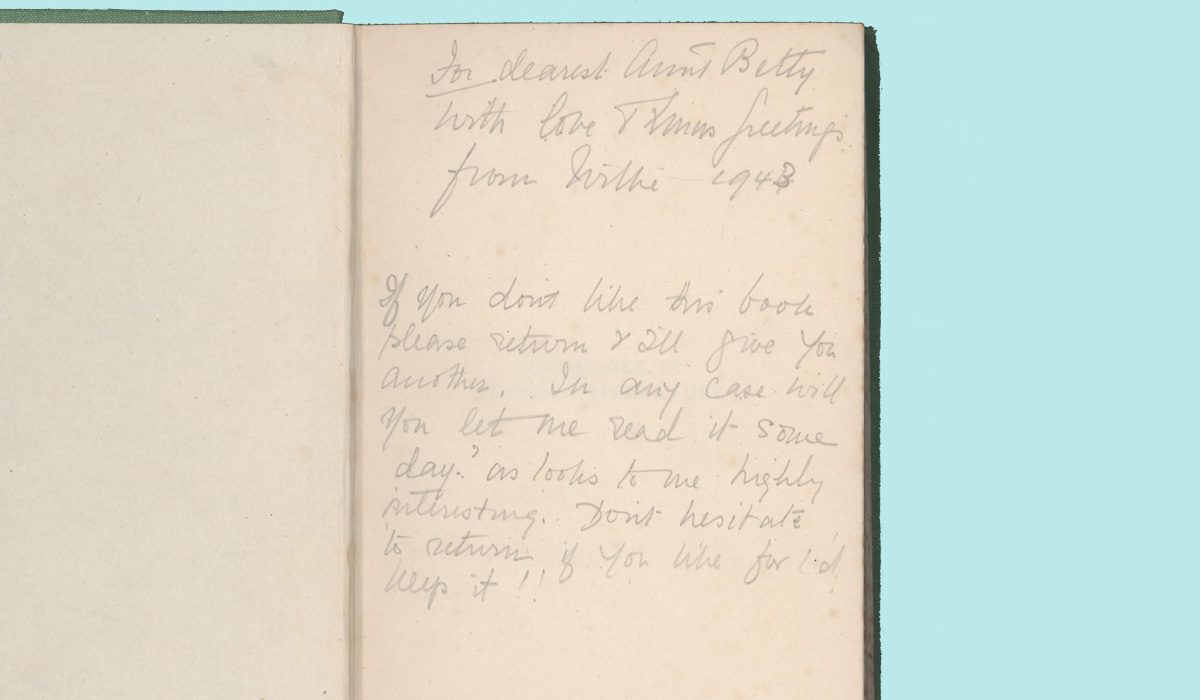
Inscription in Frontispiece in A.C. Ward's 'Landmarks in Western Literature', 1932, BGL1235
For Dearest Aunt Betty…
Inside a 1943 edition of Landmarks in Western Literature by A.C. Ward, a book once gifted to a certain Aunt Betty, is a handwritten inscription from Barns-Graham, on the inside front cover:
“For Dearest Aunt Betty with love … from Willie 1943. If you don’t like this book please return and I will give you another. In any case, will you let me read it some day? as looks to me highly interesting”
There is a light-hearted suggestion that the recipient might “return” the book, which became materially true. Decades later, the volume found its way back into Barns-Graham’s library. What feels like prophecy threads through those words, as though Barns-Graham somehow sensed the long arc of time that would stretch between the moment the book changed hands and the day it quietly surfaced again.
The inscription reads as an active exchange between friends. Barns-Graham both gives the book away and expresses her own wish to read it because it “looks highly interesting”. It tells us a little about the generosity, humour, and the circulation of books within her relationships. It gets at something frequently encountered whilst working with the library, that cataloguing tells us of warmth and seclusion of a book just as much as the physicality and bibliographic information.
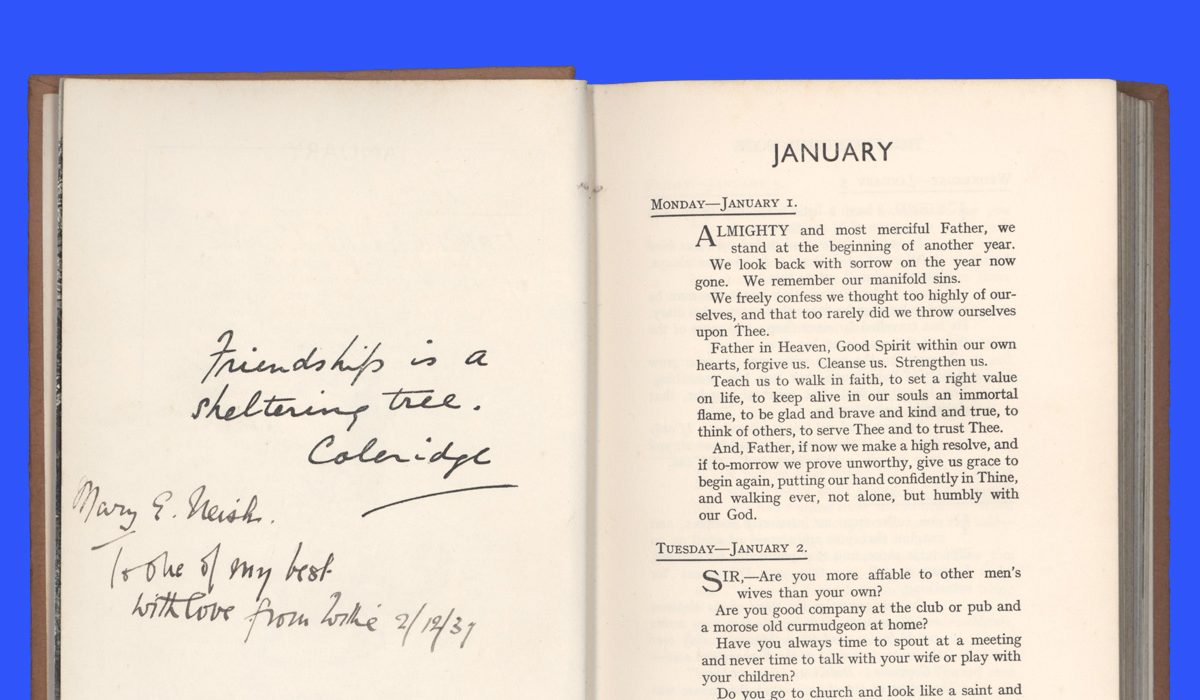
Inscription in Francis Gay's 'The Friendship Book', 1940, BGL1227
To One of the Best, With Love
This became more and more apparent across the collection. Another reaccessioned volume, The Friendship Book by Francis Gay, was inscribed to Mary G. Neish in 1939:
“Friendship is the sheltering tree. Mary G. Neish. To one of my best, with love from Willie.”
A book concerned with friendship, is itself a material enactment of friendship. Its later return to Barns-Graham’s shelves transforms and uplifts it again, from gift into memorial. The archive inherits is not just an object but a body of feeling, the weight of the thing itself, and the emotional life that had always clung to it.
Gifts, we tend to assume, leave you. That’s the whole point of them really. Yet the reaccessioned books complicate this movement. They return carrying histories of the people who lived with them, the people Barns-Graham gifted them to. I think of them as emotional boomerangs, sent outward in affection, absorbed into another person’s daily life, and eventually brought back again.
Social dimensions of books have long been recognised within material culture studies. As Leah Price suggests in How to Do Things with Books in Victorian Britain, books have functions beyond reading alone. They circulate as gifts, memorials, decorative objects, and tokens of exchange. Similarly, H.J. Jackson’s work on marginalia demonstrates how inscriptions and annotations preserve forms of engagement that exceed the printed text itself. Within Barns-Graham’s library, inscriptions are evidence of readership and her relationships. When working within an artist’s library, it’s easy to slip into the myth of access trap. It’s helpful to keep in mind that ownership of a book does not equal engagement and that perhaps annotations cannot be read as intentions. An artist’s book choices can become powerful identity signals that we can run away with. In observing reaccessioning, and the annotations that come with it, a more concrete possibility can be imagined because the exchange is something that is certain. The library records an emotional world alongside an intellectual one. Both feel equally real.
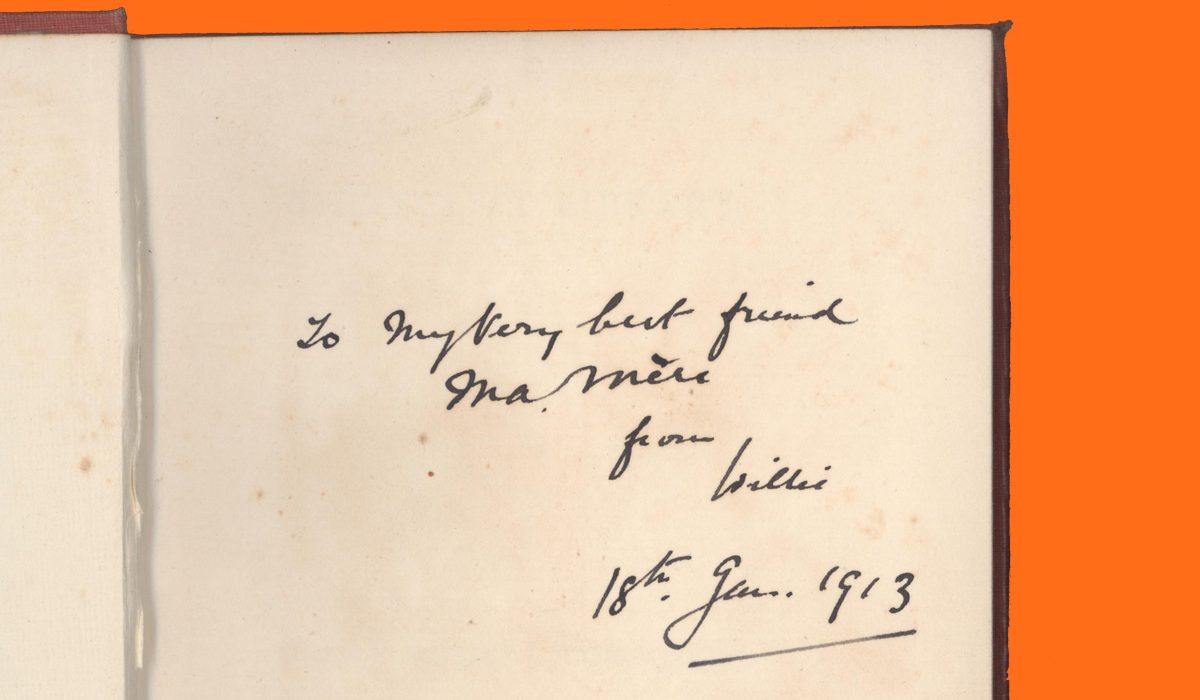
Inscription in Frontispiece, G.T Ferris' 'Great Musical Composers', late 1800s, BGL1229
To My Very Best Friend…
This is evident in another early inscription, written inside a copy of Great Musical Composers by Ferris:
“To my very best friend, ma mère. from Willie.”
The inscription is brief, just six words. The recipient is anonymous; in fact, being written in January 1913 (when Barns-Graham was only a few months old) it’s likely this book was gifted by Barns-Graham’s father on her behalf to her mother. It’s the language of someone writing quickly, privately, for specifically one reader. These are not grand declarations intended for public display. They are everyday acts of writing preserved accidentally through archival survival.
Another affecting example in the collection is a copy of Treasures of World Art by Nicholas Fry, gifted by Barns-Graham to her mother for Christmas in 1987. The inscription reads:
“To Dearest Mother who is 98 11/12 at this time with love from her eldest-born Wilhelmina who is 75 1/2 at this time.”
There is great precision with which both ages are recorded. Not ninety-eight, but “98 11/12”. Not seventy-five, but “75 1/2”. The inscription seems intensely aware of temporality and mortality, placing mother and daughter within a shared moment of advanced age. There is a tenderness in the specificity of the numbers. The book is both a Christmas present, and testament of their survival and longevity. As it is preserved, the inscription now functions like a temporal marker, fixing an otherwise fleeting moment.
Spending time with these books has opened onto larger questions about what an artist’s library is really for. The instinct is to treat such collections as intellectual repositories, e.g. windows onto influence, habit, curiosity, the shape of a working mind. Barns-Graham’s library delivers all of this. To me the reaccessioned volumes serve something wider, harder to categorise. The library becomes a kind of emotional cartography, its shelves charting invisible networks of exchange through the mute, but outstanding snippets of evidence that the objects were passing between hands.
This is apparent while cataloguing inscriptions, annotations, and loose inserts throughout the collection. Some books have handwritten recipes such as “Leek and Sorrel Soup” folded into pages or lists of birthdays and addresses written quickly in pencil. Others preserve postcards, newspaper clippings, or travel brochures. Individually these traces could just be incidental, collectively they sketch a life often absent from institutional histories of artists. The archive can document not only artistic production, but the infrastructures of care, domesticity, and sociability surrounding it.
There is an important archival dimension to these discoveries. Cataloguing necessarily involves systems of reduction and classification. Descriptions condense complex objects into metadata fields and short notes. Books such as these do not function as informational tools. Their inscriptions continually reopen questions about use, exchange, and emotional significance which pull you back into the ever-shifting nature of human relationships.
What happened between 1943 and whenever that copy of Landmarks in Western Literature came back? Did Aunt Betty know she’d return it? Did Barns-Graham ever read it? The archive cannot fully answer these questions, and this incompleteness is meaningful. As Verne Harris notes, archives always remain partial, preserving only fragments of larger and irrecoverable histories. The reaccessioned books feel shaped by these sorts of conditions.
The books carry those relationships forward materially. Handwriting can preserve a gesture, tone, affection and personality. Reading through the inscription in these volumes, Barns-Graham emerges as a friend, daughter and correspondent. In this way, the library can offer a more personal portrait of her than bibliographic data can. It is more private, daily and more her. These books moved outward into other lives and find their way back. Their journeys complicate assumptions about ownership, permanence, and absence. Long after the people named in the inscriptions are gone, the books still hold traces of Barns-Graham’s affection, humour, and intimacy within their pages. Together, they transform the library from a record of reading into a record of relationships.